Ecommerce email marketing is the use of email to sell, educate and build loyalty with people who have visited or bought from your store. Shopify’s Swedish guide describes email as an owned channel: you control the content and the distribution. The stores that earn the most from it do not rely on occasional newsletters. They build automated flows around customer behavior, segment their lists, and measure revenue per recipient rather than opens.
This guide covers what to build, in which order, what results are realistic, the Swedish and EU rules you must follow, and how to keep your mail out of the spam folder.
TL;DR
- Automated flows (welcome, abandoned cart, post-purchase, winback) earn far more revenue per send than one-off campaigns, so build them first.
- Segment by behavior and lifecycle stage. Sending the same message to everyone is the most common way to waste a list.
- Judge success by revenue per recipient, conversion and repeat purchase rate, not open rates alone.
- In Sweden, marketing email to consumers needs prior consent under section 19 of the Marketing Act, with a narrow exception for existing customers.
- Authentication (SPF, DKIM, DMARC), clean lists and easy unsubscribing protect your sender reputation.
Table of Contents
- Why email is the retention channel for online stores
- The flows every online store should build first
- Campaigns: what they are still good for
- Segmentation and personalization that move revenue
- Metrics: measure revenue, not applause
- Swedish and EU rules for promotional email
- Deliverability: getting to the inbox
- Our perspective
- When to bring in a specialist
- A 90-day plan to get started
- FAQ
- Sources
Why email is the retention channel for online stores
Paid traffic is rented. Every visitor you buy has to be bought again next month. Email gives you a direct line to people who already know you, which makes it the natural home for retention: second purchases, replenishment, loyalty and winning back lapsed customers.
The evidence on returns points the same way, with a caveat on how to read it. Benchmark figures come from software vendors’ own datasets and vary a lot by industry and method, so treat them as direction, not promises. What the datasets agree on is the gap between automated and manual sending. In its 2025 data, Omnisend reports that automated emails generated $3.41 per email sent against $0.155 for campaign emails, and converted at 1.49% against 0.08%. Klaviyo’s benchmark report puts the advantage of flows at 6 to 8 times more revenue per send.
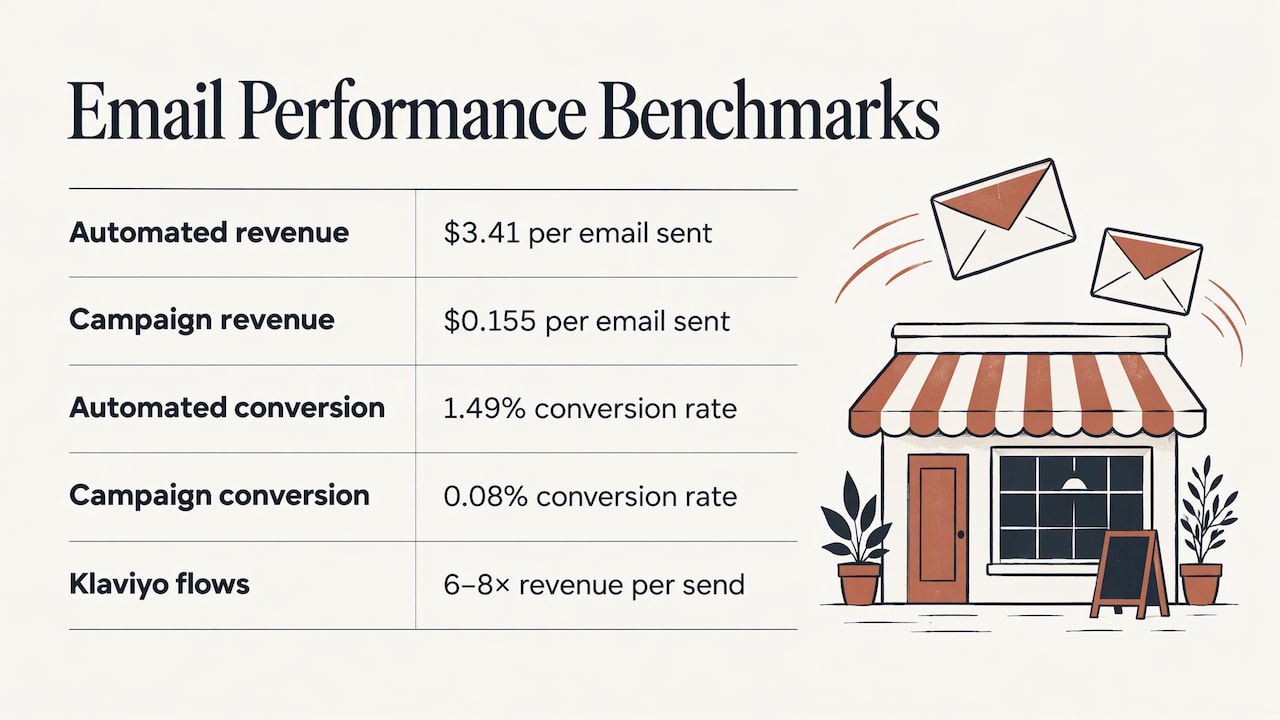
The practical conclusion: a store that sends only a weekly newsletter is leaving its best-performing emails unwritten.
The flows every online store should build first
An automated flow is a series of emails triggered by something a customer does or does not do. Build them in the order below, because each one catches revenue that is otherwise lost.
Welcome series
A new subscriber is at peak interest. A welcome series introduces your brand, shows your bestsellers and gives a reason to buy now. Its job is the first purchase. Measure first-purchase conversion and click rate. Klaviyo’s data lists the welcome series among its highest revenue-per-recipient flows, at $2.65 per recipient.
Abandoned cart
This is usually the single most valuable flow. In the same Klaviyo data it earns $3.65 per recipient. A common structure, described by BigCommerce, is three emails:
- Within one to three hours: a friendly reminder with the products in the cart.
- Within 24 hours: add urgency or social proof such as reviews.
- Within 48 to 72 hours: introduce an incentive only if it is needed.
Not every shopper needs a discount. Test the third email with and without an offer, and see whether you are training customers to abandon carts on purpose.
Browse abandonment
Someone looked at a product and left. Browse abandonment emails reawaken that interest. A peer-reviewed study by Goic and colleagues (2021) in the Journal of Interactive Marketing found that these emails increase revenue, that recommending popular items beat recommending close substitutes, and that messages sent soon after the trigger worked better.
Post-purchase
The order confirmation is not the end of the conversation. A post-purchase flow helps the customer get value from the product, asks for a review and sets up the second order. Its metric is repeat purchase rate. This flow has a lower revenue per recipient in the benchmark data ($0.41), but it feeds lifetime value, which is the point of retention.
Replenishment, winback and VIP
- Replenishment: for consumables, remind customers when the product is likely to run out.
- Winback: reactivate customers before they are gone for good. Shopify’s guide notes that the trigger can be a defined period without activity, such as 45 days, based on your own customers’ buying rhythm. Look at your own repurchase data to set it.
- VIP and loyalty: keep your best customers close with early access, perks and recognition.
We go deeper on each of these in our guide to retention email automation workflows.
Keep flows from colliding
Once several flows run at once, one customer can qualify for a cart reminder, a post-purchase thank-you and a sale blast on the same day. That is how you get complaints. Set priority rules and suppression logic so a customer only gets the most relevant message. This is invisible when it works and very visible when it does not.
Campaigns: what they are still good for
Flows do not replace campaigns. Campaigns carry launches, seasonal sales, restocks and content. They build the rhythm of your brand and keep the list warm. The mistake is to treat them as the whole program.
Good campaigns share three traits:
- A reason to send. Every email gives the reader something: news, inspiration, advice, an offer or a clear next step.
- A consistent rhythm. Regular sending matters more than frequent sending. Pick a cadence you can keep.
- A segment, not the whole list. Send launches first to people who bought in that category or clicked recently.
If you run a newsletter, our piece on turning a newsletter into a sales channel shows how to make each send earn its place. For more ideas on lifting existing sends, see 10 ways to improve your email campaigns.
Segmentation and personalization that move revenue
Segmentation divides contacts by interest, behavior, customer type or position in the customer journey. Klaviyo’s benchmark data reports that segmented emails drive twice the open rate and three times the revenue per recipient of batch-and-blast sends.
Start with segments you can build from data you already have:
| Segment | How to define it | What to send |
|---|---|---|
| New subscribers, no purchase | Joined, zero orders | Welcome series, bestsellers, first-order offer |
| First-time buyers | One order | Post-purchase education, review request, cross-sell |
| Repeat buyers | Two or more orders | Early access, loyalty benefits |
| High-value customers | Top spenders by lifetime value | VIP perks, exclusive launches |
| Lapsed customers | No order or click in your typical repurchase window | Winback, then re-engagement |
| Category browsers | Viewed a category repeatedly | Browse follow-up, relevant recommendations |
Personalization goes beyond a first name. Recommend products based on what someone viewed or bought, send replenishment reminders at the right time, and adjust the tone for a loyal customer versus a first-time subscriber.
Testing without fooling yourself
Test one variable at a time, such as subject line, send time or call to action, and wait for a sample large enough to mean something. A test on 200 recipients rarely tells you anything. Write down what you learned so the next test builds on it.
Metrics: measure revenue, not applause
Open rates have become unreliable because of privacy features that inflate them, and the benchmark datasets disagree: Omnisend’s 2025 data shows an average open rate of 30.22% across industries, and its overall click-through rate was 0.88%. Use them as a rough reference only. Your own trend line is worth more than anyone’s average.
Track these instead:
- Revenue per recipient, by flow and by campaign.
- Placed order rate (conversion) and click rate.
- Repeat purchase rate among email-engaged customers.
- Unsubscribe and complaint rates, which warn you of relevance problems.
- Share of total store revenue attributed to email, with flows and campaigns split out.
A healthy program usually shows flows producing a disproportionate share of email revenue from a small share of sends. If your flows make up a minor part of email revenue, that is the first place to look for growth.
Swedish and EU rules for promotional email
This is the part that cannot be improvised. The following is a summary of the rules as commonly described; if you are unsure about a specific case, consult a lawyer or the relevant authority.
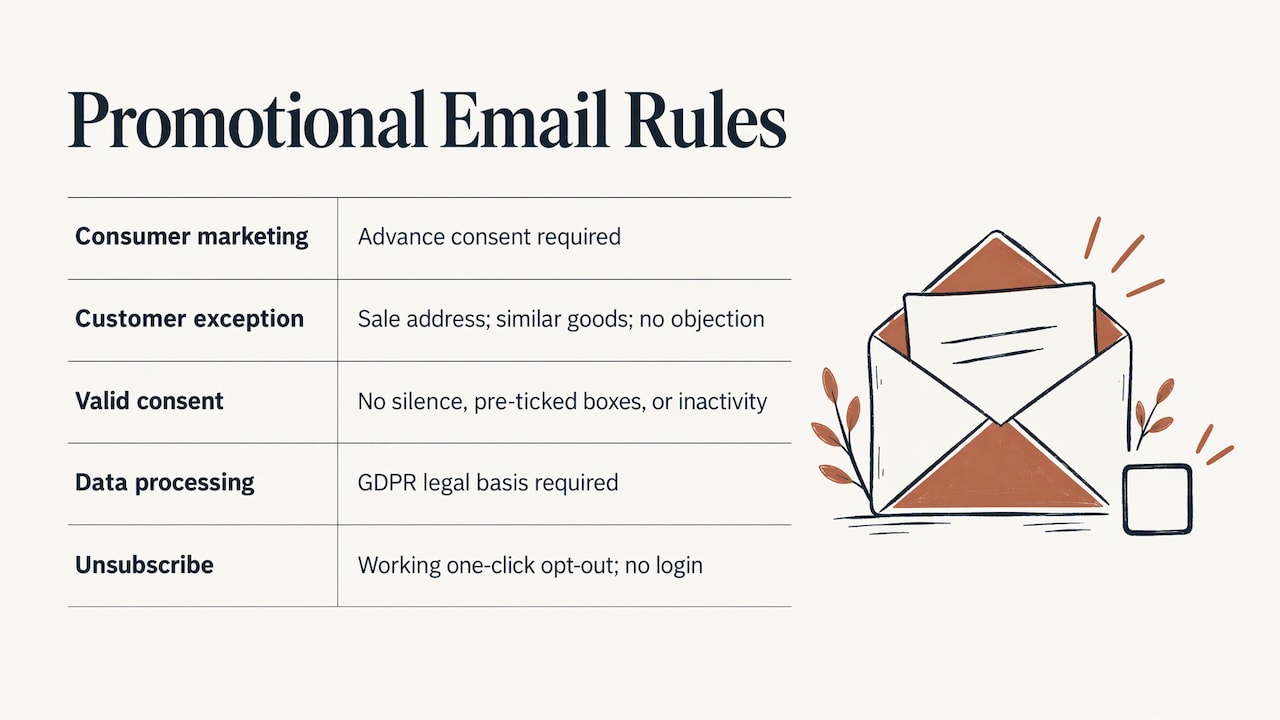
Consent for consumers. Under section 19 of the Swedish Marketing Act, you may email a natural person for marketing only if they have consented in advance. Morling Consulting also points out that a commercial newsletter can count as direct marketing even when the recipient pays nothing.
The existing-customer exception. Section 19(2) allows marketing to customers whose address you obtained in connection with a sale, for your own similar products, provided they have not objected and were given a clear, free and easy way to object when you collected the address and in every later message. Setup Analytics’ Swedish overview summarizes this as a narrow exception, and notes that double opt-in is not a legal requirement but is standard practice for documenting consent.
What counts as consent. GDPR requires a clear affirmative act. Recital 32 on EUR-Lex states that silence, pre-ticked boxes or inactivity do not constitute consent. For your checkout this means an unticked box the customer ticks themselves, and a record of when and how they did it.
Data processing. Collecting data, profiling and segmentation still need a GDPR legal basis, even where the email itself falls under the Marketing Act, according to Morling Consulting. Write your segmentation logic into your privacy policy.
Unsubscribe. Every marketing email must include a working way to ask for marketing to stop. Make it one click and never require a login.
Deliverability: getting to the inbox
The best flow earns nothing in the spam folder. The basics, as described in Courier’s deliverability guide:
- Authenticate your domain with SPF, DKIM and DMARC.
- Send from a real domain with a reply-to address that reaches a person.
- Remove hard bounces immediately and suppress addresses that complain.
- Write honest subject lines that match the body, and include a plain-text version.
Two details trip up many stores. First, passing SPF or DKIM is not enough: Egressif explains that the passing domain must align with the visible From domain, which is a common cause of DMARC failures. Second, complaint rates matter. The same source lists thresholds of below 0.10% at Gmail (never reaching 0.30%) and below 0.3% at Yahoo, and notes that Gmail requires one-click unsubscribe for bulk marketing mail.
Regular list cleaning supports all of this. A re-engagement flow that asks inactive subscribers to confirm interest, followed by suppressing those who do not respond, protects your reputation and lowers your sending costs.
Our perspective
Most stores we meet do not have an email problem. They have a coverage problem. The welcome series was written years ago, the cart flow has one email, nobody built a winback, and the newsletter does all the work.
We treat retention as a system, not a send schedule. That means starting from the data: who buys again, when, and what they bought first. Then we build flows around those moments, segment by behavior, and report on revenue per recipient so you can see what each flow earns.
What we care about most is that it feels like having an in-house team. We work inside your workflows, report constantly and keep optimizing, rather than handing over a one-off setup and disappearing. Email and SMS then become the most profitable channels you own, because they compound.
Thea
When to bring in a specialist
If you have the time and skills, you can build most of the above yourself. Many marketing managers and store owners find the bottleneck is not knowledge but capacity: flows need data cleanup, design, copy, testing and constant tuning, and that competes with everything else on the roadmap.
This is where we come in. Accent Studio runs email and SMS retention for e-commerce brands: strategy, automation flows, campaigns, design, segmentation, list cleaning, migration and continuous optimization. Our clients report results such as a 27% increase in repeat purchases and 20x ROI on specific campaigns.
The offers published on our solutions page are:
- Retention Accelerator: from $6,900 per month, full retention management.
- Retention Accelerator+: from $4,900 per month.
- Klaviyo Monthly Management: from $2,500 per month, ongoing management of your Klaviyo account.
- Inbox Intel: Deep Dive Email Audit: a thorough audit of your current email program. See the audit.
Not sure which fits? Book a strategy call and we will look at your list, your flows and your goals. You can also see how we work in the Bedding Co. case study, or start with our free Email Accelerator Framework.
A 90-day plan to get started
- Weeks 1 to 2: audit. Check authentication, list health, consent records and which flows exist. Note revenue per recipient for each.
- Weeks 3 to 5: foundations. Fix authentication and sign-up forms, then build or rebuild the welcome and abandoned cart flows.
- Weeks 6 to 8: lifecycle. Add browse abandonment, post-purchase and replenishment where it fits.
- Weeks 9 to 12: retention. Launch winback and VIP flows, add suppression rules, and begin structured A/B tests.
- Ongoing: review revenue per recipient monthly, clean the list quarterly and test one thing at a time.
FAQ
Can you really sell through email marketing?
Yes. Email is built for it, especially to people who already know your store. The strongest sales come from flows triggered by behavior, such as abandoned carts and welcome series, rather than from general announcements.
How often should an online store send email?
Consistency matters more than volume. Pick a cadence you can keep, such as one or two campaigns a week, on top of your automated flows. Watch unsubscribe and complaint rates; if they rise, send less or segment more tightly.
Do I need consent to email customers in Sweden?
For consumers, generally yes: section 19 of the Marketing Act requires prior consent, with a narrow exception for existing customers and similar products when they were offered a clear way to object. Use an unticked checkbox, keep a record and include an easy unsubscribe in every email.
Which flows should I build first?
Start with the welcome series and abandoned cart, then add browse abandonment, post-purchase, winback and VIP flows. These follow the customer’s journey and typically earn more per send than campaigns.
Sources
- Shopify Sweden: e-postmarknadsföring för e-handel
- Omnisend: Email Marketing Benchmarks
- Klaviyo: Ecommerce email marketing automations
- Klaviyo: Reduce your unsubscribe rate
- BigCommerce: Abandoned cart emails
- Goic et al. (2021), The Effectiveness of Triggered Email Marketing, Journal of Interactive Marketing
- Morling Consulting: Direktmarknadsföring och GDPR
- Setup Analytics: Sweden overview
- EUR-Lex: GDPR, Regulation 2016/679
- Courier: How to land in the inbox, not spam
- Egressif: Email deliverability best practices