
The best Black Friday email marketing plan is not a deeper discount. It is a sequence built around your own customer data: who gets early access, who gets the offer, who gets left out, and what happens to every buyer after Cyber Monday. Brands that treat BFCM as one retention program, not a four-day blast, protect margin and keep the customers the sale brings in.
This is the framework we use with eCommerce clients at Accent Studio, a full-service email and SMS retention agency for Klaviyo and Shopify brands. Below you get the four levers behind a strong plan, a timeline that works whether you are starting in August or compressing it into the final weeks, and the offer, segment, copy and send-time decisions that decide results.
TL;DR
- Plan the margin first. Set the minimum margin you will accept, then choose offers that fit inside it instead of copying last year’s percentage.
- Segment before you design. VIPs, engaged subscribers, never-buyers and lapsed customers should each get a different message and a different moment.
- Warm up your sending. Black Friday volume is a sharp break from normal patterns, so build up gradually and trim unengaged contacts first.
- Give every email one job: one offer, one deadline, one button. Keep the same visual system across the whole sale.
- Treat December as part of the campaign. Post-purchase, review, loyalty and winback flows are where Black Friday customers become repeat customers.
Table of Contents
- Why Black Friday email marketing deserves its own plan
- The four levers behind a strong BFCM plan
- The Black Friday email timeline
- Offers that protect margin
- Segmentation and list health before you send
- How to write Black Friday emails that get opened and clicked
- How many emails to send, and when
- Cyber Monday emails
- What to do after Cyber Monday
- Our perspective on BFCM email marketing
- Get a full-service BFCM and retention program
- FAQ
- Sources
Why Black Friday email marketing deserves its own plan
The volume at stake is large. Adobe Analytics data reported by TechCrunch put US online spending on Black Friday 2025 at a record $11.8 billion, up from $10.8 billion the year before. Your shoppers are in that traffic, and so are every competitor’s emails in their inbox.
Email is the channel where you own the audience. Paid costs rise in Q4, and social reach is not guaranteed. Your list, your SMS subscribers and your Klaviyo data are the assets that do not get more expensive in the busiest week of the year.
That is also why the plan has to be more than “send more.” Inboxes get crowded, subscribers get fatigued, and a brand that discounts hard every year teaches its customers to wait for the next sale. A good plan decides in advance what each segment should receive and what the sale should do for the business after it ends.
The four levers behind a strong BFCM plan
We build every plan around four levers. Discount depth is only one of them, and usually the least interesting.
1. Offer structure
Decide the offer before anything is designed. The question is not “how much off?” but “what is the offer for each customer type, and what does it cost us?” Percent-off, tiered spend thresholds, gifts with purchase, bundles and early access all have different margin profiles.
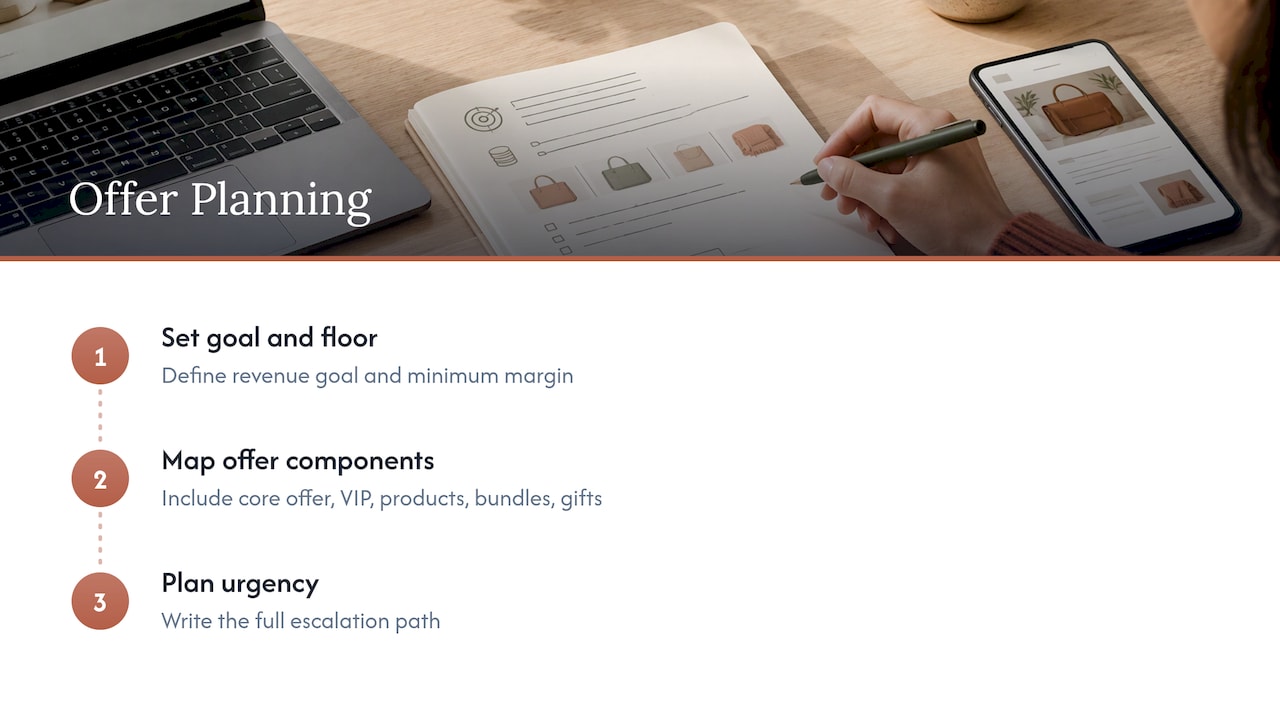
Start with a goal and a floor: the revenue you want, and the lowest margin you will accept. Then map the core offer, a VIP or loyalty treatment, featured products, any bundles or gifts, and the moments where you will create urgency. Write down the whole escalation path. If Black Friday opens at 25% and Cyber Monday jumps to 35% for no clear reason, you have trained your subscribers to wait.
2. Audience and segmentation
Your list is not one audience. A VIP who buys every quarter, a subscriber who has never purchased and a customer who bought full price last week need different emails. The segments we start with on almost every plan:
- VIPs and loyalty members: early access and exclusive perks, rather than the broadest discount.
- Engaged subscribers: people who opened or clicked recently, who carry the bulk of your sending.
- Never-buyers: first-purchase incentives and social proof, with the offer doing the heavy lifting.
- Lapsed customers: a reason to come back that acknowledges the gap.
- Category or product-interest segments: browse and purchase behavior tied to the products you are featuring.
- Recent full-price buyers: suppressed from discount sends, handled with a different message.
That last group matters. Segments need to update dynamically, so a customer who paid full price a few hours ago does not receive a discount email today. In Klaviyo this is a matter of building the segments on live conditions and adding suppression logic to every campaign and flow.
3. Channel and timing
Email carries the story and SMS carries the urgency. Decide which messages belong in which channel before the calendar fills up, and keep the two aligned so a subscriber on both lists does not get the same message twice within minutes.
Timing has two parts: the weeks-out schedule and the time of day. Both are covered below.
4. Retention after the sale
Black Friday brings in new buyers at their most price-sensitive. Whether they buy again depends on what happens next: a strong post-purchase flow, a review request, a loyalty invitation, a cross-sell tied to what they bought and a winback path for those who go quiet. Plan this before the sale, because in the final week nobody has time to build it.
For the automations that make this work, see our guide to retention email automation workflows.
The Black Friday email timeline
Black Friday falls the day after US Thanksgiving, which is the fourth Thursday in November, and Cyber Monday follows on the Monday after. The ideal timeline starts well before that. If you are reading this late, use the right-hand column of priorities: the tasks that cannot be skipped.
| Phase | When | What happens | Minimum if you are late |
|---|---|---|---|
| Foundation | 10 to 12 weeks out | Set goals, margin floor, offer structure, inventory plan | Lock the offer and the margin floor |
| List health | 8 weeks out | Authenticate your domain, clean the list, define engagement tiers, finalize segments | Suppress long-inactive contacts, build VIP and engaged segments |
| Creative | 6 weeks out | Design a single modular template system and write copy for each phase | One template, copy for three core sends |
| Warm-up | 4 to 6 weeks out | Raise sending frequency gradually to engaged subscribers, grow the list with sign-up incentives | Send to engaged subscribers only, with a modest increase in cadence |
| Teaser | 2 to 3 weeks out | Announce the sale is coming, invite people to join the VIP or early-access list | One teaser plus a VIP early-access message |
| Early access | 2 to 4 days before | VIPs and loyal customers get the offer first | Same |
| Black Friday | The day itself | Launch, reminder, last-hours message | Launch plus final-hours reminder |
| Cyber Monday | The following Monday | Extension, new angle or new products, last chance | One main send plus one last chance |
| Post-sale | The week after and into December | Thank-you, review request, cross-sell, loyalty invite, winback | Post-purchase flow live before the sale begins |
Every phase has a different job. Teasers build intent and grow the early-access list. Early access rewards your best customers. Launch sends convert. The post-sale flows turn a transaction into a relationship.
How the plan changes if you start late
Cut the creative, never the list work. A simple template with the right segments will outperform a beautifully designed email sent to the wrong people. Protect these three things first: the margin floor, suppression of recent buyers, and the post-purchase flow.
Offers that protect margin
The usual reflex is to match whatever the market is doing. A better approach is to ask which offer gets the behavior you want at the least cost.
- Tiered thresholds (“spend more, save more”) raise average order value rather than only lowering price.
- Gifts with purchase protect the headline price of your hero products and move slower-selling inventory.
- Bundles let you show value without cutting the price of any single item.
- Early access costs almost nothing and makes your best customers feel recognized.
- Exclusions keep your bestsellers or newest launches out of the deepest discount.
Whatever you choose, keep it believable. A real deadline, an honest reason for the extension and a consistent structure across the weekend keep trust intact. If you extend into Cyber Monday, say so plainly and give subscribers a reason to act that is more than a larger number.
Segmentation and list health before you send
A Black Friday send will be many times your normal volume for some brands, and inbox providers watch sudden changes. A list that has been mailed quietly all year and then receives daily promotions is the pattern that tends to hurt deliverability.
The preparation that matters:
- Authenticate your sending domain. Make sure SPF, DKIM and DMARC are configured on the domain you send from.
- Sort contacts into engagement tiers. Active, fading, at risk and inactive is a workable structure. Decisions about offers and cadence come after this, not before.
- Warm up in steps. Increase frequency gradually and lead with your most engaged subscribers.
- Sunset or reduce the unengaged. Mail long-inactive contacts less often, or not at all during peak days, and run a re-permission or winback message earlier in the autumn.
- Keep unsubscribe simple. The FTC’s CAN-SPAM guidance covers all commercial email, not only bulk sends, and requires a clear way to opt out that you honor promptly.
Our Inbox Intel deep dive email audit is built to review how an existing program is set up before a high-volume period like this.
How to write Black Friday emails that get opened and clicked
Subject lines
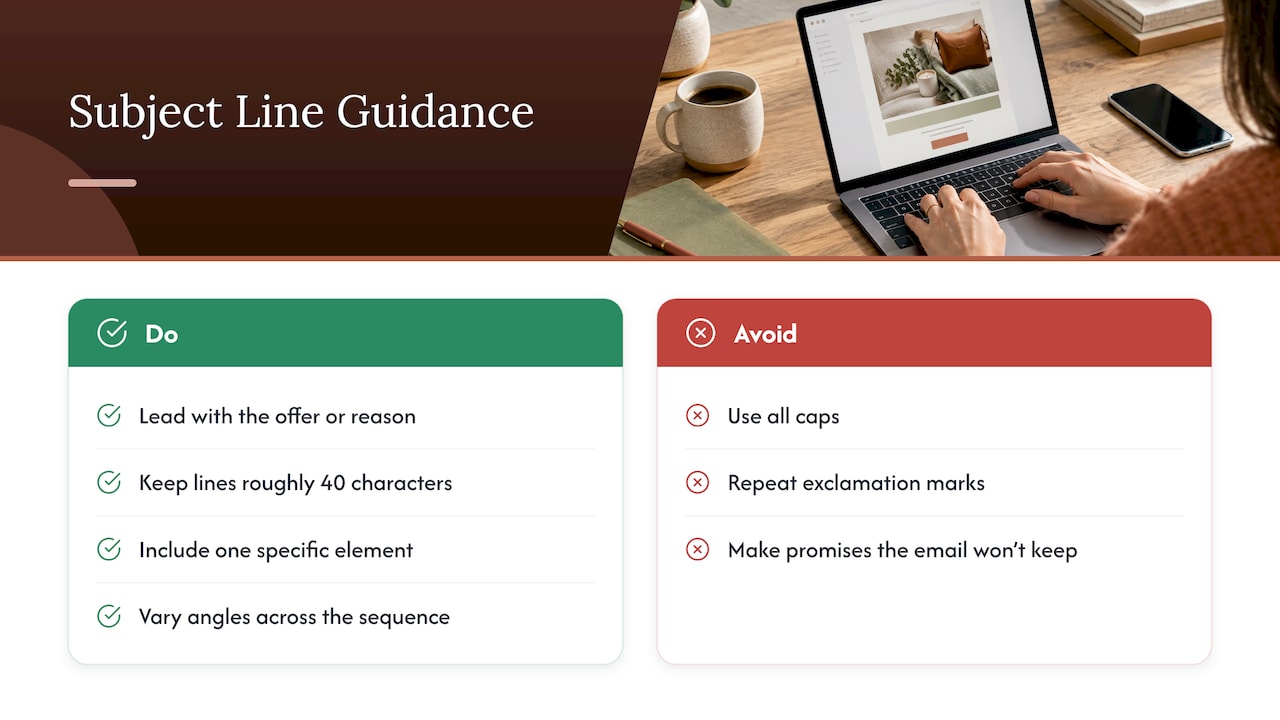
Mobile inboxes truncate early, so put the offer or reason to open in the first few words. Aim for short lines, roughly 40 characters, with one specific element: an offer, a deadline or a genuine reason for curiosity. Vary the angle across the sequence: early access, launch, reminder, last hours.
Good patterns: a clear offer and a time limit (“Early access: 20% off ends tonight”), a VIP framing (“Your early access starts now”) or a stock-based reason (“Almost gone: the bestseller returns”). Avoid all-caps, repeated exclamation marks and promises the email does not keep.
Body copy and layout
Each email gets one job, one offer and one primary button. Put the offer and deadline within the first two lines, then show featured products. Most readers see the email on a phone, so a single-column layout, large buttons and light images come first.
Develop one primary visual system for the whole sale and iterate on it. Because you will send more than usual, rebuilding every email from scratch is how errors creep in. A consistent template also makes the sequence read as one campaign rather than a series of unrelated blasts.
Personalization that is useful
First-name merge tags are the baseline, not personalization. Use behavior: products viewed, categories purchased, cart contents, customer tier. A subscriber who has browsed the same collection three times should see that collection first.
How many emails to send, and when
There is no universal number, because the right cadence depends on your list’s engagement. A reasonable structure for most brands, and a good place to start:
- A month out: a hint that something is coming, with a sign-up for early access.
- Two weeks out: a preview of the offer and products, with early access for existing customers.
- Black Friday eve: the offer, the deadline and a single call to action.
- Black Friday: short and direct, with the offer and deadline at the top.
- The day after: a last-chance message or an extension announcement.
- Cyber Monday: a fresh angle and a last-hours reminder.
Peak days can justify more than one send, especially for engaged segments, and SMS can carry the short, time-sensitive reminders. Less engaged segments should get fewer messages. Stagger sends across the day rather than sending everything at once, and use your own past BFCM data as the starting point: your open and click times from previous years are more relevant than a general average.
Send times
Treat any published send-time figure as a starting hypothesis. Morning sends tend to work for launch messages and evening sends for last-chance reminders, but your audience will tell you more. If your customers span time zones, schedule by recipient local time where your platform allows. Keep SMS out of the late evening and early morning.
Cyber Monday emails
Cyber Monday should not be a copy of Black Friday. By Monday, subscribers who wanted the offer have bought, so the email needs a different job.
- Segment by action. Exclude Black Friday purchasers from the main send, or send them a different message.
- Lead with a new angle. Extended offer, new products, bundles or a shipping deadline.
- Be honest about the extension. If the sale was announced as ending Friday, explain why it continues.
- Finish with a last-chance message in the evening.
For gift-heavy categories, a shipping-cutoff message is often more persuasive than a bigger discount.
What to do after Cyber Monday
The week after the sale is where the plan pays off or fails. New customers acquired at a discount are the most valuable audience of the quarter if you follow up well.
- Thank-you and post-purchase flow: set expectations on delivery, usage and support.
- Review and UGC requests: timed to when the product arrives, not when it was ordered.
- Cross-sell: products that complement what they bought.
- Loyalty or VIP invitation: a reason to come back that does not depend on another discount.
- Winback for non-buyers: a gentler message for people who engaged during the sale but did not purchase.
- Review the results: which segments, offers and send times worked, so next year starts from your own data.
The ecommerce email marketing guide on our site covers the always-on flows that carry this work through the year.
Our perspective on BFCM email marketing
Most Black Friday plans we see begin with the discount and end with the send schedule. We think the order should be reversed: start with what you want your customer base to look like on January 1, then work backward.
That is why our work treats BFCM as one part of a year-round retention program. Segmentation, automated flows, campaign planning, copywriting, design, implementation, reporting and ongoing optimization all feed each other. The better your flows and segments are in October, the less you need to rely on discounting in November.
We also believe the work compounds. Learnings from one Q4 shape the next one, which is why we specialize in ongoing monthly partnerships rather than one-off campaign setups, and why we act as an extension of your internal team with transparent reporting.
This article is general industry guidance. Where we describe how we work, we mean the way we structure our own engagements.
Accent Studio Editorial Team
Get a full-service BFCM and retention program
If your team does not have the capacity to run strategy, segmentation, copy, design and reporting through the busiest quarter, that is the work we take on. Our Retention Accelerator starts from $6,900 per month, Retention Accelerator+ from $4,900 per month and Klaviyo Monthly Management from $2,500 per month. You can compare them on our solutions page.
Qualified eCommerce brands can book a strategy call to talk through goals, list health and what a retention program would look like for your store. You can also see how we work in our Peta Jane Beauty case study.
FAQ
What time should I send Black Friday emails?
Start with your own past BFCM open and click data, because your audience matters more than a general average. Morning sends suit launch messages and evening sends suit last-chance reminders. Stagger sends throughout the day, and schedule by local time zone when you can.
How many Black Friday emails should I send?
Most brands do well with a handful of emails across the run-up and one to three on peak days, with SMS covering short reminders. Engaged segments can take more, and fading or inactive ones should take fewer. Watch unsubscribe and complaint rates as you go.
When should I start planning Black Friday emails?
Ideally 10 to 12 weeks ahead, when offers and margin are set, with segmentation finalized about eight weeks out. If you are starting late, lock the offer, suppress recent buyers, warm up engaged subscribers and have the post-purchase flow live first.
What should a Black Friday email include?
One clear offer, a real deadline and one main button, placed in the first lines. Add featured products, a mobile-friendly layout and relevant personalization. Keep the design consistent with the rest of the sale.
How should Cyber Monday emails differ from Black Friday emails?
Give them a new job. Exclude or separately message Black Friday buyers, lead with an extension, a new product angle or a shipping deadline, and close with a last-chance reminder in the evening.
Sources
- Black Friday sets online spending record of $11.8B, Adobe says (TechCrunch)
- CAN-SPAM Act: A Compliance Guide for Business (FTC)