
Claude Code can draft a campaign strategy brief in one session, but only if you load it with your brand context and keep a strategist in charge of what ships. For an established Shopify brand, that means the tool speeds up the writing and structuring, while audience judgment, offer rules and final approval stay with people who own retention results. This guide shows the setup, the workflow and the checks. It also explains why brands that run email and SMS at scale hand the whole program to a specialist team instead of building this alone.
TL;DR
- Claude Code reads files, drafts a brief and saves it in one session, so it works like a coworker instead of a chat window.
- Output quality tracks the context you load: voice, segments, offer rules and past performance.
- Run the brief in Plan Mode first, then approve it before anything is built.
- A human still checks claims, builds the creative and presses send.
- Brands that want strategy, copy, design, implementation and reporting handled end to end can book a strategy call with Accent Studio.
Table of Contents
- What Claude Code does differently from a chat assistant
- The context you load decides the quality
- A step-by-step workflow for the brief
- What a retention brief should contain
- Checking the draft before anyone acts on it
- Save the workflow and keep it focused
- Where the tool stops and strategy starts
- Our perspective
- Turning briefs into a retention program
- FAQ
- Sources
What Claude Code does differently from a chat assistant
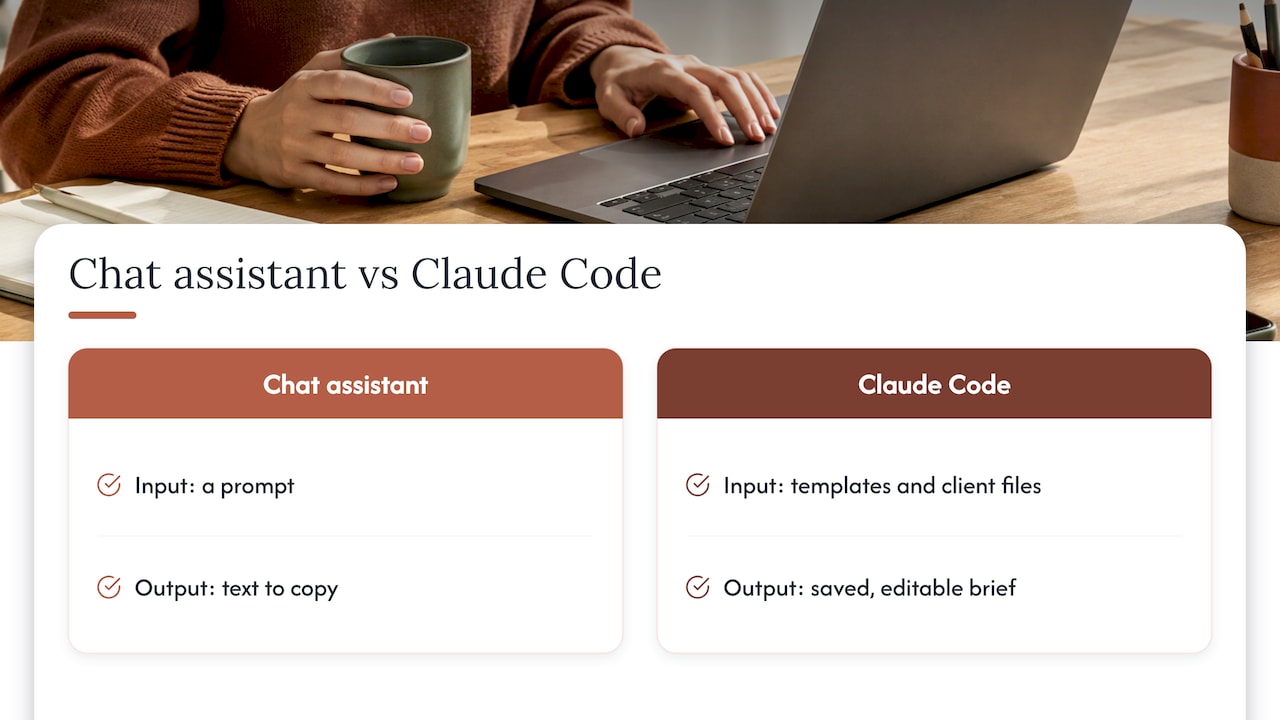
A chat assistant answers a prompt. Claude Code works inside a folder on your machine. It can read a brief template and client context from files, draft the brief and save it in the same session, and it can read performance CSVs to draft executive summaries that flag anomalies. That is the shift: the brief lands as a file your team can open, edit and version, not as text you copy out of a window.
Anthropic’s own marketing team shows the pattern. One of its marketers built reusable workflows in Claude Code that take campaign data, existing copy and keywords, check them against brand voice and product accuracy, and export a file for manual review. Notice the last step. The export is reviewed by a person before anything goes live.
For a retention team, the same logic applies to briefs for a Black Friday send, a winback push or a VIP launch. The model assembles and structures. You decide.
The context you load decides the quality
Generic input produces generic briefs. One guide for marketers puts it bluntly: Claude cannot infer what you know about your customers, so audience knowledge, voice and past top performers must be pasted in.
For an email and SMS brief, build a small set of context files and keep them in the project folder:
| File | What goes in it | Why it matters |
|---|---|---|
| Brand voice | Tone rules, words you use and avoid, sample emails that performed | Keeps drafts sendable |
| Audience and segments | Segment definitions, size, purchase behavior, lifecycle stage | Stops “all customers” briefs |
| Offer rules | Discount ceilings, exclusions, free-gift thresholds, stacking rules | Prevents off-policy promotions |
| Product data | Hero products, bundles, stock constraints, claims you can and cannot make | Keeps copy accurate |
| Performance history | Past campaign results by segment, flow benchmarks | Calibrates targets to real numbers |
| Constraints | Send capacity, SMS compliance rules, calendar conflicts | Makes the plan executable |
One published approach recommends persistent context files covering company, product and goals, including what you are not building, so the model avoids unsuitable recommendations. In retention the equivalent is a short “what we never do” list: no sitewide discounts on hero SKUs, no SMS to unconfirmed contacts, no claims outside approved language.
Inputs a brief needs before drafting
Across the published brief workflows, the core inputs repeat: goal, audience, offer, timeline, constraints and research notes. One brief-generator skill also tells the model not to invent missing data such as conversion rates, spend or performance history. Put that rule in your own instructions. A brief that quietly fills a gap with a plausible number becomes a plan built on fiction.
For eCommerce specifically, one workflow suggests feeding in recent performance, customer reviews and support logs, winning creative, product data and brand and compliance rules. Reviews and support tickets are especially useful for retention, because they hold the language customers use to describe why they reorder or why they leave.
A step-by-step workflow for the brief
- Set up the folder. Create a project folder with your context files, a brief template, and subfolders for briefs and reports. Put standing rules in a CLAUDE.md file so every session starts with them.
- Start in Plan Mode. One guide describes Plan Mode as letting marketers read files and analyze data without making changes, refine a plan, and only then implement. Ask Claude to read prior briefs and your context files, then propose angles, segments, channel roles and timing.
- State the objective as a number. “Increase repeat purchase rate among second-order customers” is a direction. A brief needs a primary metric, a baseline from your Klaviyo and Shopify reporting, and a target you set yourself.
- Define segments in behavioral terms. Ask for segments built from order count, days since last order, product category and engagement. Reject any segment you cannot build in Klaviyo with your current data.
- Assign channel roles. Email carries story and depth. SMS carries urgency and short reminders. Ask the model to say which message goes where and why, and to respect consent and frequency limits.
- Map the calendar. Have it lay out send dates, dependencies (creative, inventory, offer approval) and a suppression plan so the same customer is not hit by overlapping campaigns.
- Set success metrics and reporting. Revenue per recipient, repeat purchase rate, unsubscribe and complaint rates, and a reporting cadence.
- Approve, then implement. Exit Plan Mode only after you have edited the plan. Operationally precise prompts name the task, the source files, the rules, the output, the checks and the point where Claude must stop for approval.
What a retention brief should contain
Published templates agree on a common skeleton: a summary, objectives, audience insights, key messages, channel strategy, timeline, budget and success metrics. One framework simplifies this to Goals, Audience, Creative, Channels and Stakeholders as a recurring structure.
For email and SMS, adapt it like this:
- Objective and baseline. One primary metric, a few secondary ones, and where each is tracked.
- Segments and exclusions. Who receives it, who is suppressed, and why.
- Offer and rules. Exactly what is promised, the limits and the end condition.
- Message architecture. Core message, supporting proof, and the angle per segment.
- Channel and cadence plan. Which email and SMS go out, when, and what triggers a follow-up.
- Creative requirements. Modules, imagery, product feeds and approvals needed.
- Risks and dependencies. Stock, deliverability, consent, and anything that could force a delay.
- Measurement. What you will read after the send and what decision it informs.
Watch benchmark defaults that some prompt packs bake in. They are generic across industries and can mislead a retention plan. Your own account history is the right baseline.
Checking the draft before anyone acts on it
Speed creates a trap: a fluent brief feels finished. Treat it as a first draft that must pass checks.
- Claims and numbers. One guide warns that an unverified stat in a brief becomes a published stat in an ad. Ask for a source note beside every product claim and verify figures yourself.
- Required sections and arithmetic. Use explicit verification prompts, such as confirming every required section is present and that budget totals add up.
- Brand and compliance. Compare against your voice file and your offer rules. Check SMS language against your consent and carrier requirements.
- Segment feasibility. Confirm each segment can actually be built from the data in Klaviyo.
- Human sign-off between stages. Anthropic’s marketing example ends with manual review before upload, and the same discipline applies to briefs: research, brief, draft and QA can be accelerated, but each move forward needs a person’s approval.
A useful stance: the strategist, not the model, decides what survives review.
Save the workflow and keep it focused
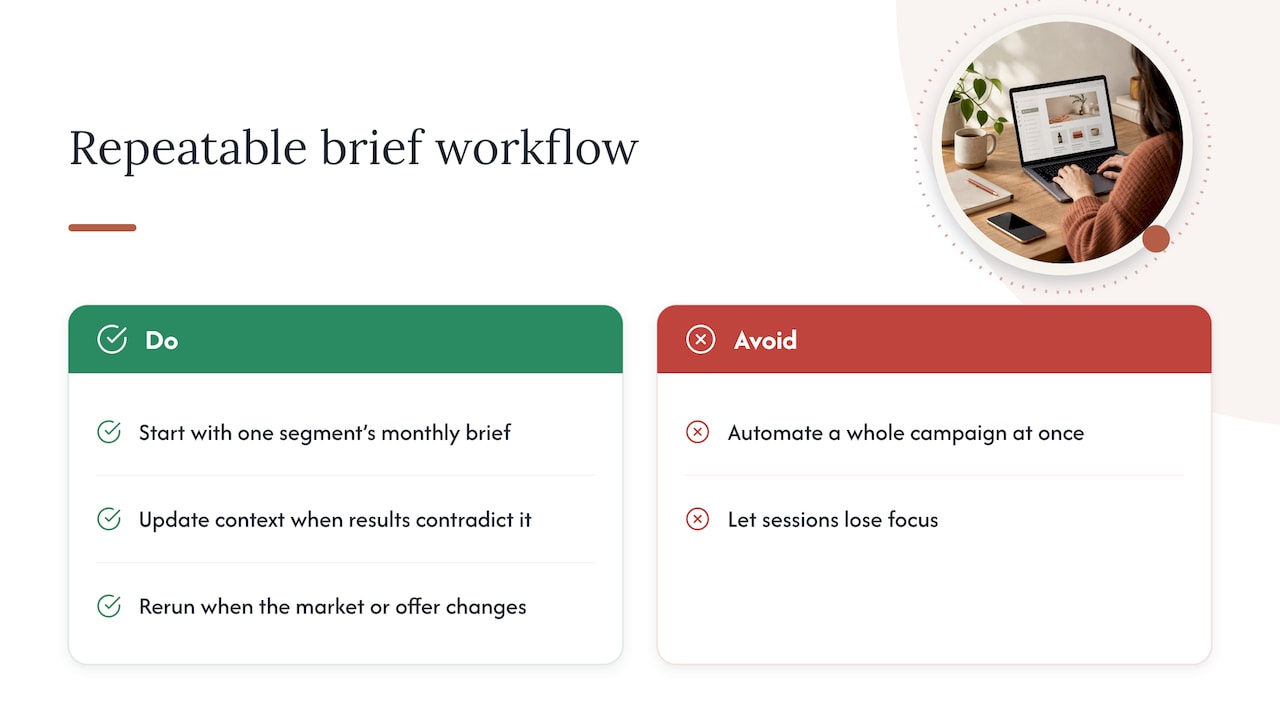
Once a brief works, turn it into a repeatable command. One guide recommends storing it as a saved command file with objectives, metrics, audience pain points, messages, channels, timeline, budget and risks, with project context in CLAUDE.md. Keep sessions focused, because context is limited and performance can degrade before it fills.
Start small. Anthropic’s guidance is to begin with a small, repetitive task rather than automate a whole campaign. A good first candidate is the monthly campaign brief for one segment. Update your context files when results contradict them, and rerun your strategy exercise when the market or your offer changes.
Where the tool stops and strategy starts
Persistent skills preserve guidelines and checks, but they do not replace creative direction, platform knowledge, strategic decisions or client relationships. In practice, a brief still leaves work undone: pulling real reviews, confirming flavor or shade names, building the email in Klaviyo, QA across devices, and sending. It also cannot tell you whether the list is healthy, whether a flow is leaking revenue, or which of ten angles deserves your next quarter.
Our perspective
We think of AI-assisted briefing as a faster way to get to the real work, not a replacement for it. A brief is only valuable when it connects to a program: segmentation that reflects how customers actually buy, flows that run every day, campaigns planned against the calendar, and reporting that tells you what to do next.
That program is what we manage for our clients. Accent Studio works as an extension of your team and handles strategy, segmentation, automated flows, campaign planning, copywriting, design, implementation, reporting and ongoing optimization, with a focus on repeat purchases and customer lifetime value.
Our view is that tools like Claude Code reward teams with clear context and disciplined review. A retention partner supplies both on an ongoing basis, so the brief is the start of a measured monthly cycle, not a one-off document.
Accent Studio Editorial Team
Turning briefs into a retention program
If your team would rather not assemble the context files, QA routines and production pipeline in-house, Accent Studio manages the full email and SMS program for established Shopify and DTC brands. Our monthly engagements are listed on the solutions page: Klaviyo Monthly Management from $2,500 per month, Retention Accelerator+ from $4,900 per month and Retention Accelerator from $6,900 per month. If you want a read on your current setup first, the Inbox Intel email audit is available.
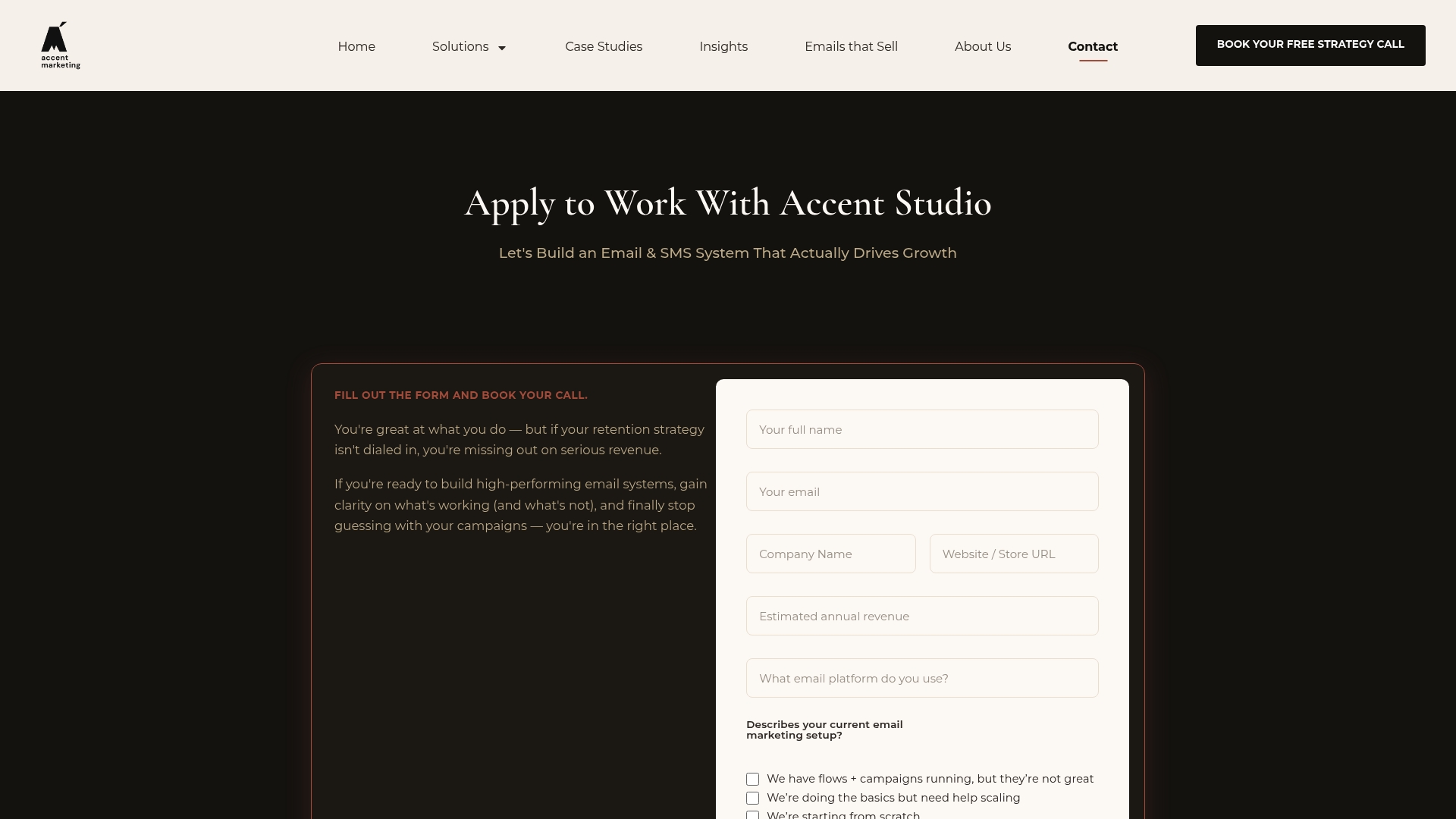
Qualified eCommerce brands can book a strategy call to talk through goals and fit. For related reading, see our guides on retention email automation workflows and a Black Friday retention playbook.
FAQ
Can Claude Code write a campaign brief on its own?
It can draft one from your files and a template, and save it in the same session. The draft is only as good as the context you provide, and a strategist should edit and approve it before anything is built.
What should I give Claude Code before asking for a brief?
Give it the goal, audience and segments, offer rules, timeline, constraints, product data, brand voice and past performance. Add customer reviews and support language for angles. Tell it not to invent missing figures.
How do I stop it from making things up?
Require a source note beside each claim, ask it to flag missing inputs, and verify numbers yourself. Add explicit checks for required sections and budget totals, and keep a human sign-off before any stage moves forward.
Should I automate the whole campaign?
No. Give it a bounded task with clear inputs, outputs, checks and a stopping point. Briefing is a strong place to start because a person reviews the result before design, build and send.
Sources
- How Anthropic uses Claude in marketing
- Claude Code for Performance Marketers
- Claude Code for Ecommerce Brands: AI Creative Team Guide
- 5C Loop for Marketers
- How to Set Up Your PM Context Files in Claude Code
- Campaign Brief Generator
- Claude Code for Marketers: Complete Guide (2026)
- Claude Code for Marketing: A No-Code Guide 2026
- Write a Campaign Brief: Claude Code for Marketers
- The secret to making Claude better at marketing
- Best Claude Skills for Marketing and Paid Ads