Customer welcome or onboarding automation means a set of triggered emails (and often SMS) that welcome a new customer, teach them to get value from what they bought and guide them to a second order, without anyone sending those messages by hand. For an online store, the working version is short: a welcome message right after signup or first purchase, one or two follow-ups that depend on behavior, and a clean exit once the customer has acted. This guide shows how to build it, what to send and when, which Swedish rules apply, and how to measure it.
TL;DR
-
Onboarding is a flow that starts at signup or first purchase and ends when the customer has reached first value or placed a repeat order. Automate the triggers, keep the messages human.
-
Send the welcome email immediately, a nudge after 24 to 48 hours of inactivity, then guidance and a check-in. Every email pushes one action.
-
In Sweden, order and delivery messages are transactional, but marketing emails need consent or the existing-customer exception, plus an easy opt-out in every message.
-
Judge the flow by activation, first-to-second purchase rate and revenue per email, not by opens.
-
Test timing and content against a control group, and review the flow on a schedule.
Table of Contents
What customer onboarding means in e-commerce
Onboarding is the stretch between a person’s first contact (account creation or first order) and the moment they use your product with confidence. Shopify describes it as introducing new customers to a product and teaching them how it works, usually through list signup or account creation, a welcome email and educational resources such as tutorial videos, FAQs and blogs. The same page frames it in three stages: welcome, education, and adoption or repeat purchase.
For a store, that translates into three jobs:
-
Confirm and welcome. Set the tone, say what happens next, and make the brand feel like a real company with a point of view.
-
Help the product land. Show how to use, style, size, brew or care for what they bought, so the first experience is a good one.
-
Earn the second purchase. Point to the next logical product or action once the first one has been experienced.
One useful way to think about it comes from customer success practice: onboarding exists to help the customer reach the result they bought for, and retention follows from that. Treat it as a value delivery flow, not a discount delivery flow.
Can it be automated? Yes, almost entirely. The triggers, timing, branching and exits are rule-based. What you cannot automate is the thinking: which single action matters most for each product, and what the customer needs to hear to take it.
How an automated onboarding journey works
Under the hood, every onboarding flow is the same machine: an event starts it, timers space it out, and customer behavior steers it.
A clear technical example is an event-driven onboarding pipeline described in Nylas documentation. After signup the system saves a customer record, sends a tracked welcome email and starts a 48-hour timer. It reacts to opens, clicks and bookings. If there has been no engagement when the timer runs out, it sends a follow-up and updates the customer’s onboarding state. You do not need to build this from scratch in an e-commerce setting, because email and SMS platforms ship the same logic as visual flows, but the model is worth keeping in your head:
-
Trigger: account created, newsletter signup, first order placed.
-
Wait: a delay that gives the customer time to act before you prompt them.
-
Condition: has the customer opened, clicked, ordered or visited a product page?
-
Branch: if yes, skip ahead or exit; if no, send the next nudge.
-
Exit: the moment the goal is met, the customer leaves the flow.
The exit rule is the one most often missed. Nothing damages a first impression like a reminder to buy something the customer ordered an hour ago.
Two entry points, two flows
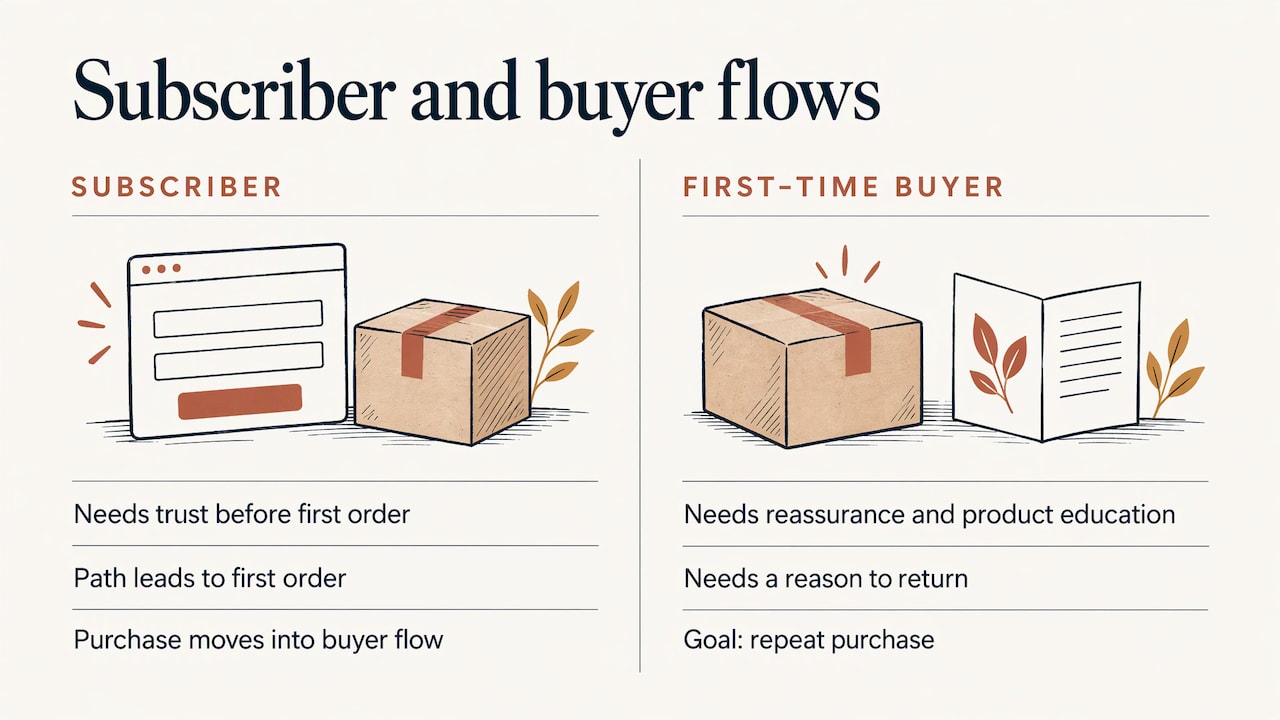
Treat a subscriber who has not bought and a first-time buyer as different people. The subscriber needs reasons to trust you and a path to a first order. The buyer needs reassurance, product education and a reason to come back. Mixing them into one sequence produces messages that are wrong for half the audience. Build two flows and make sure a subscriber who buys moves out of the first and into the second.
The onboarding emails to send, and what each one does
A common pattern, outlined by Helply, runs from an immediate welcome to a first-value reminder after 24 to 48 hours of inactivity, then guidance once first value is completed, followed by a check-in and a conversion nudge. The principle behind it is that each email drives one action. Here is how that adapts to a store:
| Step | Timing | Purpose | Single action |
|---|---|---|---|
| Welcome | Immediately | Confirm, set expectations, introduce the brand | Browse a hand-picked collection or open the order status |
| First-value reminder | 24 to 48 hours of inactivity | Help the customer start using the product, or return to the shop | Watch a how-to, view a size guide, return to the cart |
| Guidance | Day 3 to 5 | Teach care, use or styling; answer common questions | Read one guide or reply with a question |
| Check-in | Day 6 to 8 | Ask how it is going; surface support and social proof | Reply, review or contact support |
| Next step | Day 8 to 14 | Suggest a fitting second product or a loyalty step | View the recommended product |
Those day ranges follow the same Helply sequence. They are a starting point, not a law. A coffee subscription and a mattress do not share a buying rhythm.
How many emails?
A short flow usually beats a long one. Swedish agency guidance on webshop flows suggests keeping each flow to two to four emails with days between sends, and measuring orders and unsubscribes per flow instead of opens alone. Other practitioners put a standard sequence at three to five emails, with higher-priced items needing more. A sensible default is three to four for a first-time buyer, and a little more for products with a long consideration period.
What goes in each email
Welcome. Thank them, say what they will receive and how often, and give one clear next step. If you offer an incentive for subscribers, state it plainly. For buyers, lead with the order confirmation details and what happens next rather than a discount.
First-value reminder. Short and practical. A single image, a single line, a single link. If the customer already acted, this email should never send.
Guidance. This is where you earn trust. Show how to use or care for the product, tell the founder story only if it helps explain the product, and answer the question your support inbox gets most.
Check-in. Ask a real question. Plain-text style emails that invite a reply often feel more personal than another designed banner.
Next step. Recommend something based on what they bought, not a generic bestseller grid.
Timing and personalization without the robotic feel
Automation feels impersonal when it ignores what the customer did. The fix is behavior-based branching rather than more copywriting tricks.
-
Delay before asking. Customer.io’s onboarding documentation notes that timing matters and recommends a delay in the workflow so people have time to explore before being prompted for something like a profile.
-
Skip when done. Branch on the key action. If the customer has completed it, jump ahead or leave the flow.
-
Split by time window. Voyado’s Nordic case studies describe a fashion brand using conditional logic: depending on whether the customer buys within a time window, they receive either a benefits reminder or a first-purchase discount path. The same material stresses labeling customers (for example bargain hunters or those at risk of churn) and prioritizing the timing of communication.
-
Segment by product and source. Someone who bought a gift needs different guidance from someone who bought for themselves. Someone who joined through a giveaway behaves differently from someone who joined after reading a guide.
One practical detail: automations are generally forward-looking, so only people who match the trigger after launch receive the flow unless you choose to include existing matches. Decide on purpose whether your current subscribers should enter, and do not blast a backlog all at once.
Swedish rules for automated marketing emails
If you send to customers in Sweden, build the rules into the flow, not onto it afterwards. This is general information based on public summaries, not legal advice; for your specific setup, check with a lawyer or the Swedish Consumer Agency and the data protection authority, IMY.
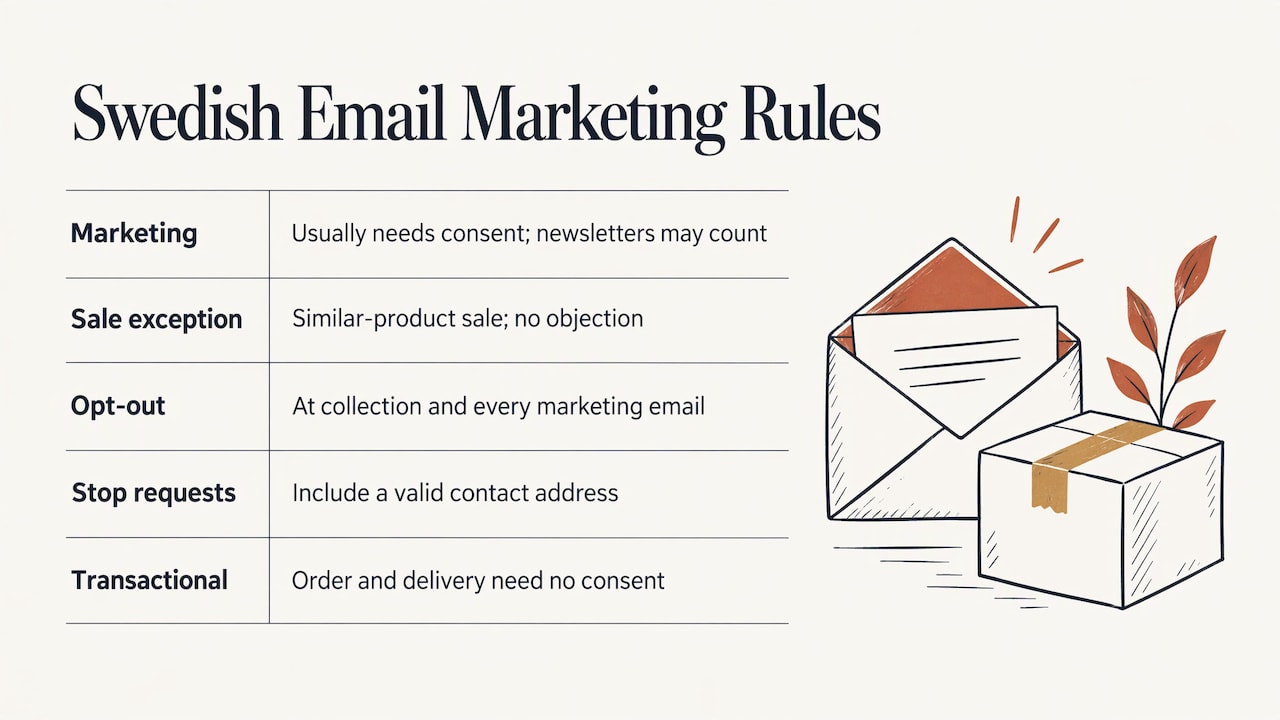
Consent and the existing-customer exception. According to a DLA Piper summary of the Swedish Marketing Act, unsolicited automated email marketing to natural persons generally requires prior consent. An exception allows it without prior consent when the address was obtained in connection with a sale of a similar product, the person has not objected, and an opt-out was offered when the address was collected and in every marketing email. Each message must also include a valid address for asking that marketing stop.
Official confirmation. An IMY decision from June 2025 describes section 19(2) of the Marketing Act in the same terms: no consent needed where there is no objection and an easy, free opt-out at collection and in each marketing message.
Free newsletters count too. A law firm summary of EU Court of Justice case C-654/23 explains that an electronic newsletter can be direct marketing when it has a commercial aim, even if the recipient pays nothing, and may fall under the same section 19 rules. The conditions it lists are details given in connection with a purchase or registration, marketing of your own similar products or services, no opt-out by the recipient, and an easy opt-out both at collection and in every message.
Transactional versus marketing. Order and delivery emails are transactional and need no consent, while marketing messages need consent or the existing-customer exception. In an onboarding flow this matters: the confirmation and shipping notice are transactional, but a message recommending another product is marketing. Keep them separate, and keep the unsubscribe link visible in the second kind.
A simple operating rule: record where and when every address was collected, what the person agreed to, and make unsubscribes take effect immediately across all flows.
Our view on onboarding automation
We see the same pattern across the e-commerce brands we work with: the welcome email is set up once, then left alone for years. It sends the same discount to everyone, ignores what the customer bought, and keeps sending after the order has been placed.
Our view is that onboarding is the first chapter of retention, not a separate project. The flow should be designed around what a new customer needs to hear in the first two weeks, and then measured against second purchases rather than opens. That is why we build it as part of a full retention program with automation, design, segmentation and ongoing optimization, and why we aim to work like an extension of your in-house team, with regular reporting you can read without a translator.
If you take only one thing from this guide: give every email one job, let behavior decide who gets what, and review the flow every quarter. A flow that is never revisited slowly stops matching your products and customers.
Thea
Metrics that show the flow is working
Open rates are easy to read and easy to misread. Better measures tie the flow to what the customer did next.
ReferralCandy’s lifecycle guide suggests measuring welcome emails by engagement and first-purchase conversion, and retention by repeat-purchase rate and time between orders. For program health it lists deliverability (aiming for 95% or more), list growth rate, engagement by segment, revenue per email sent, customer lifetime value by acquisition source and churn by cohort.
For onboarding specifically, track these five:
-
Activation rate: the share of new customers who reach your defined first-value moment. One benchmark report puts median e-commerce activation around 62 percent, with a top quartile at 81 percent. These are company-published figures, so treat them as a rough yardstick for your own trend rather than a target.
-
Time to first value: days from signup or purchase to the key action.
-
Second-purchase rate and time to it: the clearest sign onboarding is feeding retention.
-
Revenue and orders per flow: per recipient, not per send.
-
Unsubscribes and complaints per flow: an early warning that the cadence is too heavy.
Define the first-value moment per product category before you build. For skincare it might be the first full week of use; for bedding, the first night; for a gift, delivery. A flow without that definition has nothing to optimize.
Testing and improving over time
The first version of a flow is a hypothesis. Voyado’s guidance recommends testing different content and timing, using control groups to measure what the automation actually contributes, revising when results disappoint, and avoiding over-communication. In practice:
-
Hold out a control group. Keep a small share of new customers out of the flow so you can see what they would have done anyway.
-
Change one thing at a time. Test the delay between the first and second email before you test the subject line.
-
Compare long-term outcomes. A discount path may win on first-purchase conversion and lose on repeat purchases. Look at 60 to 90 days, not just the first week.
-
Audit for errors. Customer.io’s documentation recommends reviewing automations for errors or missing elements and confirming who will receive them. Check merge fields, links, exit conditions and mobile rendering every quarter.
-
Read the replies and support tickets. They tell you which question the guidance email should answer.
If you want to see what a structured approach looks like, our free email accelerator framework walks through the building blocks, and our piece on retention email automation workflows covers the wider set of flows that sit around onboarding, such as post-purchase and winback. For a look at results in practice, see the Peta Jane Beauty case study.
Getting help building it
If you would rather have a team own this than add it to your own list, this is what we do. Accent Studio runs email and SMS retention for e-commerce brands: strategy, flows, design, segmentation and ongoing optimization, with transparent reporting.
Our published starting points, all per month: Retention Accelerator from $6,900, Retention Accelerator+ from $4,900 and Klaviyo Monthly Management from $2,500. You can compare them on the solutions page. If you are not sure where your current flows stand, the Inbox Intel deep dive email audit is the place to begin, and you can book a strategy call when you are ready to talk through your store.
We also build the flows described above as part of larger retention programs, so the onboarding emails connect to post-purchase, VIP and winback messages rather than living alone.
FAQ
What is meant by customer onboarding?
It is the structured process of guiding a new customer from first signup or purchase to confident use of what they bought. In e-commerce that usually means a welcome message, setup or usage guidance, educational content and easy access to support, delivered mostly by email and sometimes SMS or on-site messaging.
Can onboarding be automated?
Yes. Triggers, delays, behavior-based branching and exits can all run automatically in an email platform. What needs human judgment is the strategy: which action each email should drive, how the content reads, and how you review results.
How many customer onboarding emails should I send?
Most stores do well with three to five emails, and some Swedish practitioners recommend keeping a flow to two to four with days between sends. Use more only for high-priced or complex products, and always remove the customer from the flow once they have completed the target action.
Do I need consent to send onboarding emails in Sweden?
Order and delivery messages are transactional and need no consent. Marketing emails need prior consent, or the exception for existing customers: the address came from a sale, you market similar products, the person has not objected, and an easy opt-out was offered at collection and in every message. For your exact setup, ask a lawyer.
Sources
-
Onboarding Email Sequence: Templates, Triggers & Examples, Helply
-
How 3 leading retail brands use marketing automation, Voyado
-
EU ruling on direct marketing, C-654/23 Inteligo Media, Morlings
-
The 2026 Customer Onboarding Benchmark Report, Perspective AI